

BRASSAI

BRASSAI took his name from the town of his birth, Brasso, in Transylvania, then part of Hungary, later of Roumania, and famous as the home of Court Dracula. He studied art at the academies of Budapest and Berlin before coming to Paris in the mid-twenties. He was completely disinterested in photography, if not scornful of it, until he saw the work being done by his acquaintance Andre Kertesz, which inspired him to take up the medium himself.

In the early thirties he set about photographing the night of Paris, especially at its more colorful and more disreputable levels. The results this project --- a fascinatingly tawdry collection of prostitutes, pimps, madams, transvestites, apaches, and assorted cold-eyed pleasure-seekers --- was published in 1933 as Paris de Nuit, one of the most remarkable of all photographic books.

Making photographs in the dark bistros and darker streets presented a difficult technical problem. BRASSAI"s solution was direct, primitive, and perfect. He focused his small plate camera on a tripod, opened the shutter when ready, and fired a flashbulb. If the quality of his light did not match that of the places where he worked, it was, for BRASSAI, better: straighter, more merciless, more descriptive of fact, and more in keeping with BRASSAI's own vision, which was as straightforward as a hammer.

When Paris de Nuit was published, the great photographer and theorist Dr.Peter Henry Emerson, then approaching eighty, wrote BRASSAI in care of his publisher, asking BRASSAI to please send his proper address, so that Emerson could send him the medal that he had awarded him for his splendid book. It is an interesting comment on the chaotic incoherence of photographic history that BRASSAI had never heard of Emerson.
from "Looking at Photographs" by John Szarkowski


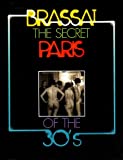
 BRASSAI: The Secret Paris of the 30's
The Secret Paris of the 30's is one of the most remarkable photographic memoirs ever published: like his predecessor Toulouse-Lautrec, Brassai chose to portray a hidden and daring subject matter.
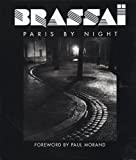
 Brassai : Paris By Night
Roaming Paris streets by night in the early 1930s, Brassai created arresting images of the city's dramatic nocturnal landscape. First published in French in 1932, this new edition brings one of Brassai's finest works back into print.
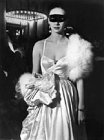
 Brassai: The Eye of Paris
Brassai: The Eye of Paris is both the catalog of an exhibition of Brassai's photographs organized by the Houston Fine Arts Museum and a valuable biography of the artist. This recognizes the artist's talents in five different media--photography, filmmaking, sculpture, writing, and drawing--but focuses on what he is best known for: lyrical and penetrating photographs of the City of Light.

 Brassai, Paris (Taschen 25th Anniversary Special Editins)
Including an extensive selection of Brassai's finest photographs and an essay describing his life and work, this book explores the world of Brassai in thematic chapters: Minotaure magazine, Paris at Night, Secret Paris, Day Visions, Artists of My Life, and Graffiti and Transmutations.
- Photography in our time leaves us with a grave responsibility. While we are playing in our studios with broken flowerpots, oranges, nude studies and still lifes, one day we know that we will be brought to account: life is passing before our eyes without our ever having seen a thing.

